For two decades, “Google” hasn’t just been a company; it has been a verb. To “Google” something meant to find the answer. But in 2026, that definition is breaking.
If you have tried to search for a recipe or a product review recently, you know the struggle: scrolling past four sponsored ads, dodging pop-ups, and reading 2,000 words of SEO filler text just to find out how long to boil an egg.
Enter Perplexity AI.
Founded by former OpenAI and Meta engineers, Perplexity is positioning itself not as a search engine, but as an “Answer Engine.” It claims to cut through the noise, cite its sources, and deliver pure information without the ad-clutter.
But can a startup really kill the giant? In this exhaustive Perplexity AI vs Google Search comparison, we spent 30 days using Perplexity as our default browser. We tested it on coding, shopping, local news, and academic research to see if it’s time for you to change your homepage.
Table of Contents
The Fundamental Difference: Links vs. Answers
To understand the Perplexity AI vs Google Search war, you must understand the architecture.
Google: The Librarian
Google is an indexer. When you ask it a question, it pushes you towards other websites. Its business model relies on you clicking links (and ads).
- The Incentive: Google needs you to stay on the search page to see ads, or click through to partner sites.
Perplexity: The Analyst
Perplexity is a synthesizer. It uses Large Language Models (LLMs) like GPT-4o and Claude 3.5 Sonnet to read the top 10 search results for you, summarize them, and present a coherent answer with footnotes.
- The Incentive: Perplexity sells a subscription (Pro). Its incentive is to give you the answer as fast as possible so you keep subscribing.
In our Perplexity AI vs Google Search testing, this fundamental difference in incentives is why Perplexity feels cleaner. It works for you, not for the advertisers.
Round 1: Accuracy and Citations (The Trust Factor)
The biggest criticism of AI is “Hallucinations.” Does Perplexity lie?
Perplexity AI
Perplexity’s “Secret Sauce” is its citation system. Every sentence it generates has a small number next to it [1]. If you hover over that number, it shows you exactly which article, study, or news report that information came from.
- The Test: We asked, “What is the current interest rate for a 30-year fixed mortgage in Florida?”
- The Result: Perplexity gave the exact percentage, cited three financial news sources from today, and broke down the trend over the last month. Perplexity allows you to use models like Claude 3.5 Sonnet vs GPT-4o inside their interface
Google Search (and AI Overviews)
Google recently rolled out “AI Overviews” (SGE) to compete. The rollout was… rocky.
- The Test: When asked similar financial questions, Google’s AI Overview was generally accurate, but the “Featured Snippets” below it were often cluttered with sponsored loan calculator ads that made it hard to find the real average.
Winner: In this round of Perplexity AI vs Google Search, Perplexity wins on trust. The ability to instantly verify the source of an AI claim makes it safer for research than a standard chatbot.
Round 2: The User Interface (The “Clean” Web)
User Experience (UX) is where the battle of Perplexity AI vs Google Search gets heated.
The Google Experience
Google has become a visual assault.
- Sponsored Shopping Ads (Top row).
- Sponsored Text Ads (First 3 links).
- SEO Spam: The first organic result is often a 5,000-word blog post filled with fluff because the writer is trying to rank for keywords.
The Perplexity Experience
Perplexity looks like a Zen garden.
- The Search Bar: “Where knowledge begins.”
- The Answer: A clean text summary.
- Related Questions: Suggestions for follow-up searches.
- No Ads: (Currently).
The Verdict: Using Perplexity feels like using the internet in 2010—before it got cluttered. For pure readability, the Perplexity AI vs Google Search comparison isn’t even close. Perplexity dominates.
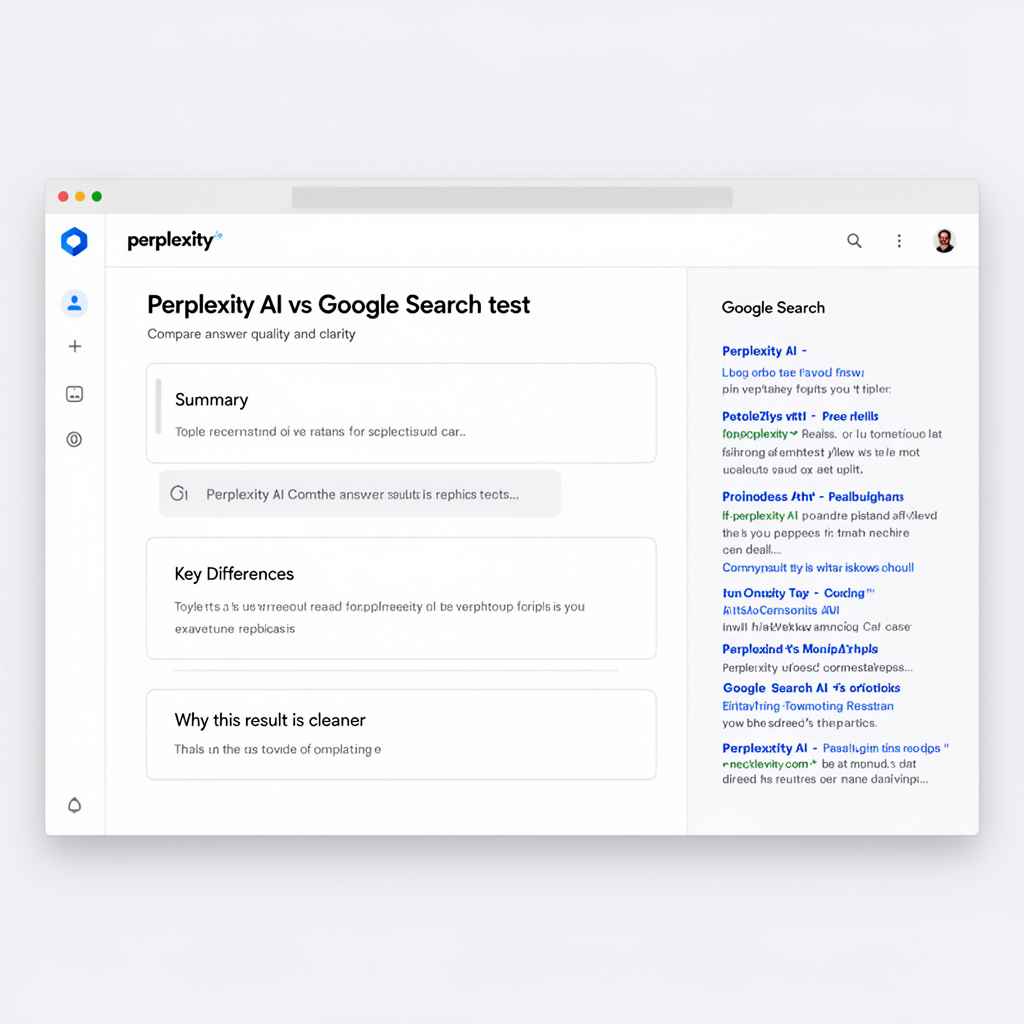
Round 3: Model Flexibility (The “Pro” Feature)
This is a feature that Google simply cannot match. When you pay for Perplexity Pro ($20/month), you aren’t locked into one AI model.
You can go into settings and choose the “Brain” of your search engine:
- GPT-4o: For general reasoning and speed.
- Claude 3.5 Sonnet: For coding and nuanced writing.
- Sonar Large (Llama 3): For uncensored, open-source reasoning.
In the context of Perplexity AI vs Google Search, Google forces you to use their model (Gemini). Perplexity lets you be model-agnostic. If GPT-4o is down or acting lazy, you switch to Claude 3.5 instantly. This flexibility is a massive selling point for power users.
Round 4: Local Search and Shopping (Google’s Fortress)
So far, Perplexity looks great. But where does it fail? The Perplexity AI vs Google Search battle shifts when we leave the realm of “Information” and enter the realm of “Action.”
The “Pizza” Test
We searched: “Best pizza place open right now near me.”
- Perplexity: It scraped Yelp and TripAdvisor lists. It gave a summary of “highly rated places.”
- Google: It showed a Map. It showed live opening hours. It showed a button to “Call” and a button to “Order Delivery.”
The “Shopping” Test
We searched: “Buy Nike Air Force 1 size 10.”
- Perplexity: Gave a summary of the shoe’s history and links to the Nike store.
- Google: Showed the “Shopping Graph”—prices across 15 stores, inventory status nearby, and visual cards.
Winner: Google. For “Navigational” (Maps) and “Transactional” (Buying) intent, Google still owns the infrastructure. Perplexity is for learning; Google is for doing.
Round 5: Coding and Technical Research
Developers are mass-migrating away from Google. Why? Because StackOverflow is dying, and Google results are filled with SEO-spam tutorials.
In our Perplexity AI vs Google Search coding test, we asked: “How to center a div in CSS using Grid.”
- Google: Gave a list of W3Schools links and some Reddit threads. You have to click through and read.
- Perplexity: Generated the exact code snippet, explained how
place-items: centerworks, and cited the MDN Web Docs.
For developers, Perplexity acts like a “Live StackOverflow.” It synthesizes the documentation into a solution.
The “Copilot” Feature: Search Agents
Perplexity has a killer feature called Copilot (recently renamed to “Pro Search”). This turns a search into a conversation.
If you ask Google: “Plan a trip to Tokyo.”
Google gives you generic travel blogs.
If you ask Perplexity Pro: “Plan a trip to Tokyo.”
Perplexity pauses and asks you clarifying questions:
- “How many days are you staying?”
- “What is your budget?”
- “Do you prefer history or nightlife?”
Once you answer, it builds a custom itinerary. In the Perplexity AI vs Google Search comparison, this “Agentic” behavior makes Perplexity feel like a travel agent, while Google feels like a brochure rack.
The Impact on SEO and Content Creators
We must discuss the elephant in the room. If everyone uses Perplexity, what happens to bloggers?
In a Perplexity AI vs Google Search world, Perplexity gives the answer without the user clicking the link. This is called “Zero-Click Search.”
- The Danger: If users don’t click, publishers lose ad revenue. If publishers die, Perplexity has no data to train on.
- The Solution: Perplexity is launching a “Publishers Program” to share revenue, but details are scarce.
Google is also doing this with “AI Overviews,” so content creators are losing traffic regardless of who wins the Perplexity AI vs Google Search war.
Pricing: Free vs. Paid
- Google: Free (Ad-supported). You pay with your data and attention.
- Perplexity Free: Uses a standard model, very capable for basic research.
- Perplexity Pro ($20/mo): Unlocks GPT-4o, Claude 3.5, Unlimited File Uploads, and deeper visualization.
Is it worth paying? If you do research for a living (student, writer, analyst, coder), saving 1 hour of “Googling” a day is easily worth $20/month.
Conclusion: Is Google Dead?
To conclude our Perplexity AI vs Google Search investigation: No, Google is not dead.
Google still owns “Intent.” When you want to buy a flight, find a restaurant, or look up a YouTube video, Google is the operating system of the internet.
However, for “Knowledge,” Google has lost its edge.
If you want to learn something, debug code, or research a complex topic, Perplexity AI is superior. It is faster, cleaner, and respects your time.
Our Recommendation:
Do what we did. Set Perplexity as your default browser for one week. You will likely find that you only go back to Google for Maps and Shopping. The era of “Googling” isn’t over, but the era of the “Answer Engine” has arrived. We cover the decline of Google traffic in our AI News Today roundups
Frequently Asked Questions (FAQ)
Is Perplexity AI better than Google?
For research and informational queries, yes. The Perplexity AI vs Google Search tests show Perplexity provides direct answers faster. For shopping and maps, Google is better.
Does Perplexity AI use ChatGPT?
Perplexity Pro allows you to use GPT-4o (the model behind ChatGPT) as its reasoning engine. However, unlike ChatGPT, Perplexity has real-time access to the internet.
Is Perplexity AI free?
Yes, the core search features are free. The Pro version ($20/mo) is for power users who want to switch models and upload large files.